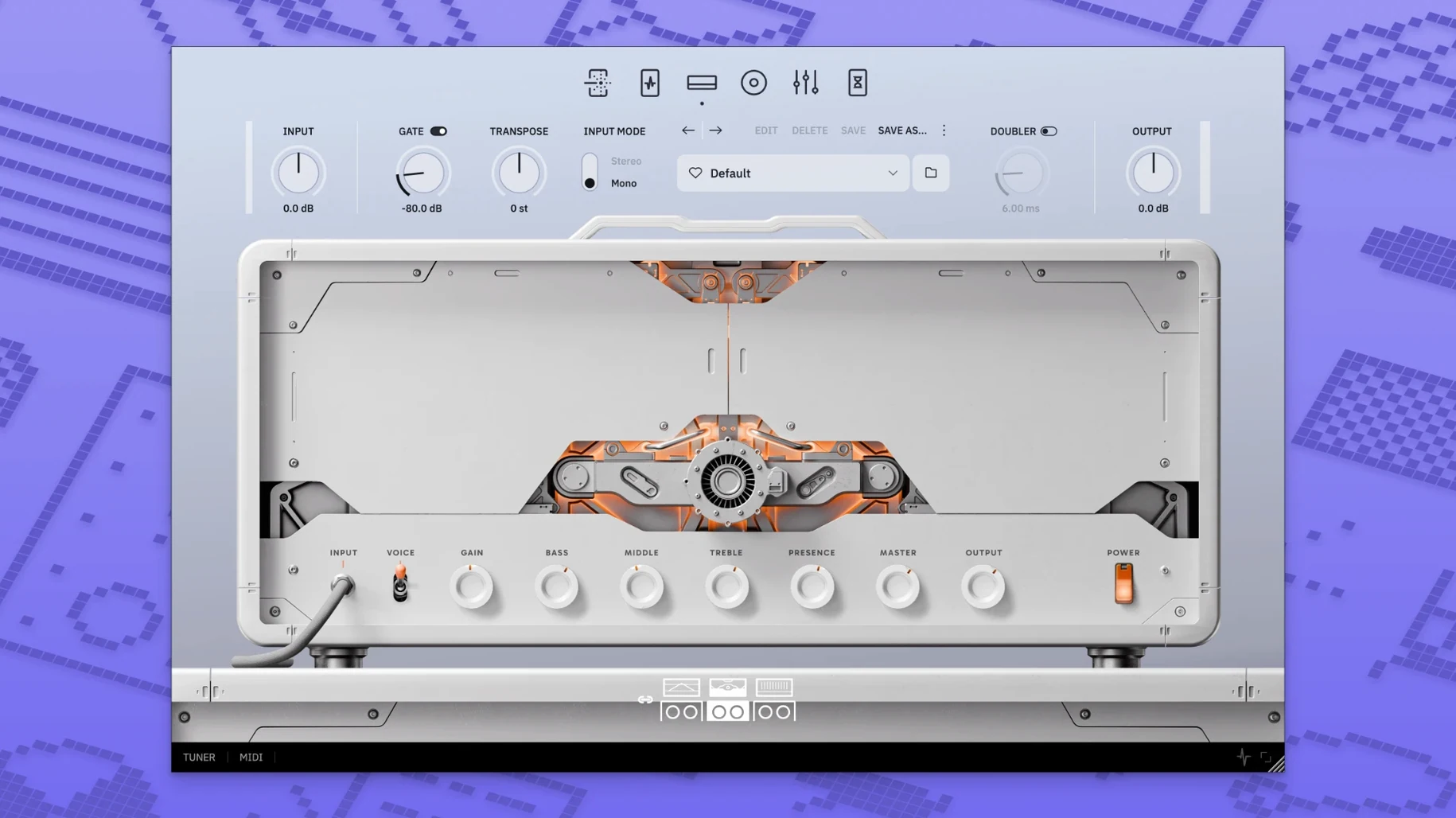
The Doubler is a proper width tool, not an afterthought. Early in the chain, one take sounds tracked twice.
1. Tune with the tuner. Add Transpose if the song wants a drop tuning.
2. The Horizon Devices Compressor, just enough to tighten palm mutes.
3. Amp and cab. Pull up the room mics for a less clinical tone.
4. Stereo delay and reverb on a bus. Keep the modulator subtle.
5. On a parallel track, Laser for gated synth chops or Glitch for stutter fills.
Tight Drop G
Down-tuned rhythm players get the most mileage. The Horizon Devices Compressor and Precision Drive together let low strings hit hard without flub—palm mutes stay tight even at drop G.
Bedroom producers working inside the box find the full signal chain a relief. No outboard gear, no re-amping. The room mics and Nolly IRs make DI tracks sound finished without a treated space.
If you already use a Quad Cortex, the plugin ports directly. Capture a tone on the hardware, open it on the desktop. Or the reverse. Either way, the same sound travels.
Gain Stacking
Stacking the Precision Drive into the Chaos distortion with both gain knobs past noon. The noise floor climbs fast and the midrange turns to mush. Back one off. Let the other do the work.
Ignoring the Global Lock. You dial in a cab and room mic balance you like, then lose it every time you audition presets. Lock the cab section first. Browse freely after.
Treating Glitch and Laser as permanent inserts. They work better on a parallel track or automated for one bar. A little goes far. A lot sounds like a plugin demo.
The transpose feature shifts cleanly, but only within a few semitones. Asking it to drop a full octave introduces artifacts. Retune the guitar for large jumps. Use Transpose for fine adjustments.
Not a general-purpose amp sim. It works when a track needs precision and a few moments of chaos.