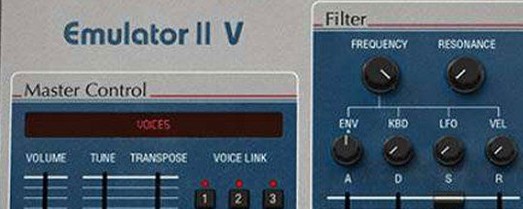
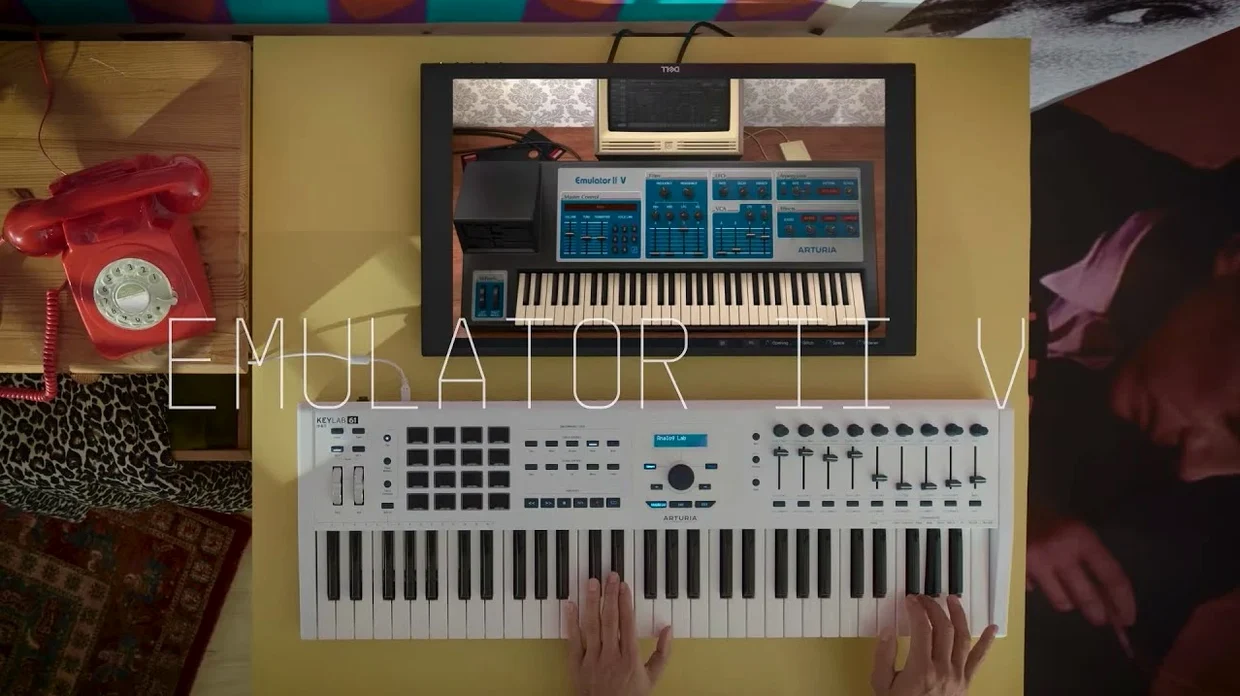
Pristine digital audio has no grain. Clarity without the dust that makes a sound stick to a mix. Emulator II V puts the dust back.
Load a choir patch, drop the sample rate and push it through the modeled output stage. The air thickens. An arpeggiated line from the modern library sits beside it without a fight, inside the 8-voice architecture.
TAE models the original converters and analog filters, so the grit sounds placed, not pasted on. Move the cutoff a little and the whole thing breathes.
Beginners treat it like a modern sampler and chase high sample rates. That misses the point. Drop the rate deliberately and listen. The magic lives around 27.7 kHz, where harmonics fold back into themselves. Another mistake: loading samples and ignoring the output stage. The VCA and VCF aren't cleanup tools. They shape the dirt. Crank the resonance before touching the filter envelope, and you lose the bite. Let the ADSR work first.
People also layer too soon. Eight voices disappear fast when each patch stacks three samples. Build a single sound you love, then duplicate and tweak. Slight detune on the second layer. Different filter movement on the third. That's where width comes from, not from piling on more presets.
Offline Activation
A few questions come up repeatedly. The instrument runs on Intel and Apple Silicon, macOS 11 onward, so most modern setups are covered. The package includes activation instructions — no external accounts or online checks to wrestle with.
People ask if it's a rompler or a true sampler. It's both. The curated library gives you 250 original presets and a spread of Synclavier and modern sources. You can also load your own audio. The 8-bit companding engine treats everything you feed it through the same signal path as the 1984 hardware.
Another common question: does it replace a real Emulator II in a mix? It adds polyphony the original never had — 32 voices instead of 8 — plus an arpeggiator and effects that didn't exist in 1984. So it's more flexible. The texture, though, lands in the same place. The converters crunch the same way.
One producer's afternoon
A lo-fi hip-hop producer opens a session with a kick and a bassline that feel too clean. She loads Emulator II V, pulls up a dusty Rhodes from the legacy bank, drops the sample rate and pushes the VCA into a slight overdrive. The chords sit behind the beat like they were sampled off vinyl.
She maps an arpeggiated bell patch across two octaves, tightens the ADSR and sends it through the modeled chorus. The part moves without cluttering the center. Twenty minutes in, she drags a vocal snippet onto a third layer. It compands through the 8-bit engine, losing its top end in a way that glues it to the Rhodes. No third-party degradation plugin needed.