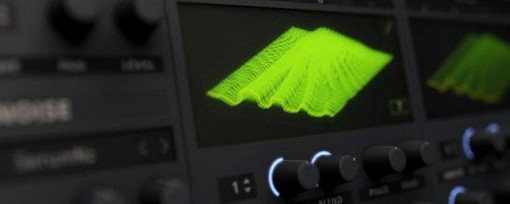
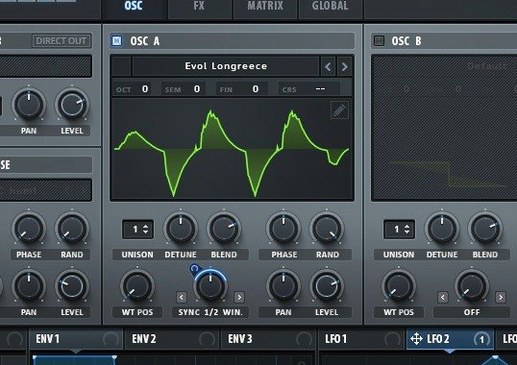
Thin patches that vanish in a busy arrangement. Serum answers with a wavetable engine built for real-time editing, not menu-diving. Import a waveform, warp it, and hear the change immediately.
The dual filter section lets you crossfade between two types—low-pass into comb, for instance—without loading a second plugin. It keeps the center of a sound solid while the edges shift. Sample-rate reduction as a filter process adds digital grit that sits differently than distortion.
Stack settings layer octaves and intervals under one keypress. A single note gains weight without cluttering the MIDI roll. Unison Warp goes further, letting each doubled voice spread independently. The stereo field widens without the usual phase wash.
Hidden shortcuts
Right-click any knob to reset it. Most people reach for the default patch instead, losing work they liked. Reset the one parameter you pushed too far and keep the rest.
Alt-drag on a wavetable frame slows the scrub to single frames. Great for finding the exact cycle where a bass hits hardest. Shift-drag on an envelope node locks it to the time grid. These are not in the manual’s first ten pages, but they shape the daily rhythm of working with it.
Double-click the waveform display to jump between zoom levels. Control-click a modulation source to see every destination it touches, highlighted in orange. When a patch feels unstable and you cannot trace why, that orange map usually shows the culprit in seconds.
Native ARM
The most common question is whether Serum runs natively on Apple Silicon. It does—ARM and x86 64-bit builds are both included. No Rosetta translation layer needed. The plugin loads as AU, VST3, and AAX, so it fits into Logic, Ableton, Bitwig, or Pro Tools without bridging.
People also ask about the wavetable import. You can drag a short audio sample directly onto oscillator A or B, and Serum slices it into a wavetable automatically. A kick drum becomes a morphing bass timbre in under ten seconds. Serum vst mac users often discover this by accident and then build entire libraries around single hits.
Some producers look for a serum crack macos solution because the 15-minute demo limit interrupts long sessions. The demo is full-featured otherwise—every filter, every unison mode, every modulation slot works. To keep a session flowing without reloads, check that your DAW's plugin sandboxing is disabled and the audio buffer is set to 512 samples or higher so the timeout resets cleanly.
Vocal chop import
You open an empty project. Insert Serum on a MIDI track. The init patch loads—a single saw wave, no effects, no modulation. You drag a short vocal chop onto oscillator A. The waveform display fills with 256 frames of spectral snapshots.
You assign an LFO to the wavetable position. Now the sound walks through the chop frame by frame, turning a static syllable into a rhythmic texture. You add a second oscillator, tune it up seven semitones, and set Unison to 4 voices with slight detune. The stereo image widens but stays clear because Unison Warp offsets the waveforms just enough.
The filter section gets a low-pass in slot A and a comb filter in slot B, with the mix knob at 40%. You map velocity to the mix, so harder notes open the comb. A touch of sample-rate reduction after the filter adds a grainy tail that ducks under the transient. By minute nine, you have a lead that responds to playing dynamics without a single automation lane.
You save the patch. You drag two more samples onto the noise oscillator and the sub. The session started with a blank init and ended with a layered, playable instrument. No tabs, no hidden menus.
Unison collapse
The first mistake is stacking unison voices to maximum and wondering why the mix collapses. More than eight voices per oscillator creates phase buildup that mono compatibility cannot survive. Start with three or four, then add more only if the sound thins out on small speakers.
Another is ignoring the global modulation matrix. Beginners often assign LFOs and envelopes from the source panels, but the matrix view shows every connection at once. When a patch behaves strangely—a filter closing when it should open, vibrato appearing only on release—the matrix reveals the conflict instantly.
Some producers grab a Serum 2 Mac crack or Serum 2 cracked Mac version and jump straight to complex wavetables without learning the basic waveforms first. The morphing engine rewards restraint. A simple square-to-sine table with careful Unison Warp settings often cuts through a mix better than a 256-frame spectral import. Complexity is easy; simplicity that holds its place takes practice.
Finally, forgetting to set voice count. Serum defaults to polyphonic, which works for pads but eats CPU on fast monophonic lines. Switch to mono or legato mode for bass and lead parts—the processor load drops, and the playing feels tighter.
Everything stays on one screen. No tabs. Just the sound, shaped in real time.