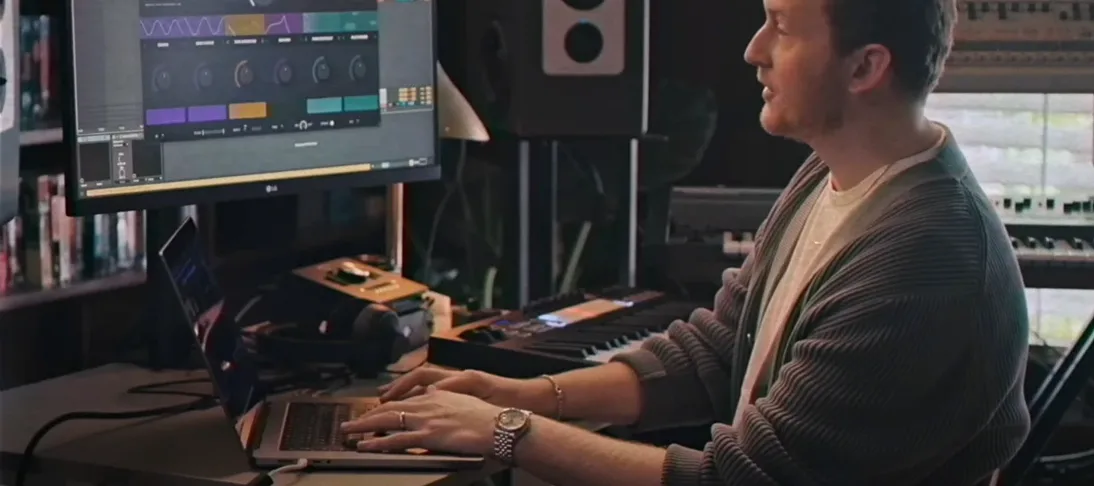
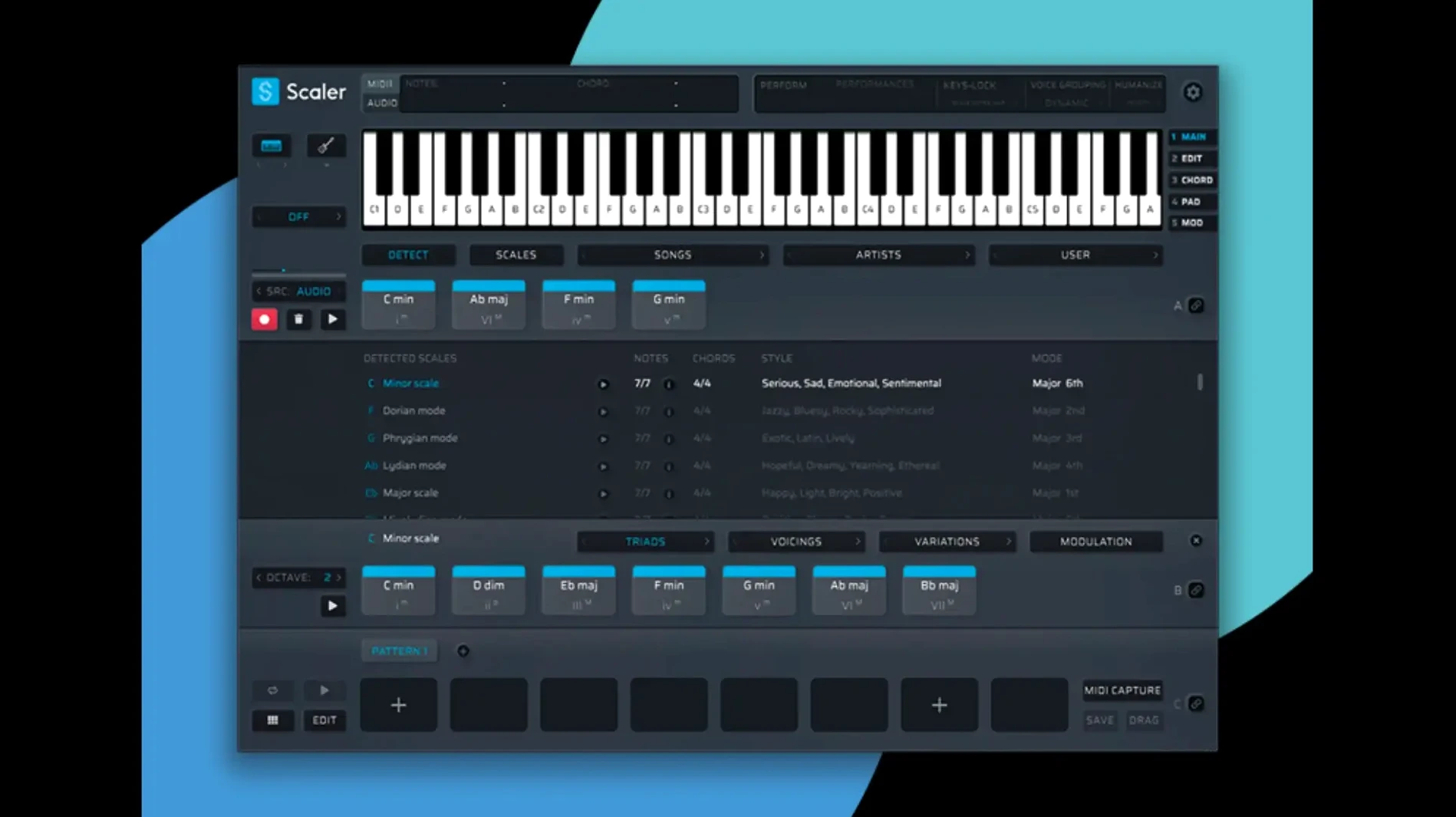
A music theory workstation that turns harmonic ideas into MIDI.
Chord generation — pick a key, a scale, a feeling, then drag the result into your DAW.
Melody and bass — let the engine suggest lines that fit your progression.
Multi-Lane Timeline — chords, melody, bass, and phrases each get their own lane; edit them side by side.
Multi-Bind — link tracks so a change in one lane ripples across the others.
Standalone or plugin — works both ways on macOS 10.15 and later, 64-bit only.
Your ear leads
Scaler 3 reads your MIDI; it does not replace your ear. You still choose what stays and what goes.
People wonder if they need theory background. No. The chord library suggests progressions by mood and genre. You pick what sounds right. Over time, the names stick — you learn by doing.
Another question: does it work with my DAW? If your host loads AU, VST, VST3, or AAX plugins, yes. The standalone app is also there when you want to sketch away from a session.
The timeline looks dense at first. Each lane — chords, melody, bass, phrases — stacks vertically. But you can ignore three lanes and work in one. The complexity is there when you want it.
Some ask if a scaler 3 download runs natively on Apple Silicon. It does. The binary covers ARM and Intel. No Rosetta needed on M-series Macs.
Coffee to chords
A songwriter opens the standalone app with coffee. She has a verse melody hummed into Voice Memos but no chords. She sets the key to D major, picks a folk-pop preset from the artist section, and listens. Four bars cycle. She drags the chords into the timeline, adds a bass lane, and tells Scaler to generate a line that roots on the one and five. It gives her three options. She picks the simplest one, exports the MIDI, and drops it into her DAW session before the coffee cools.
Nothing in that process required a keyboard. The mouse and her ear were enough.
Shift-split chords
Right-click a chord block in the timeline to split it. You can turn one bar of G major into two beats of G and two beats of E minor without opening a menu.
Hold Shift while dragging a chord to copy it. This works across lanes too — pull a chord from the progression lane into the melody lane and it snaps to the same position.
Multi-Bind stays off by default. Turn it on when you want a key change in the chord lane to shift the bass and melody together. Until then, lanes stay independent.
The plugin can host other plugins. A chord lane can run a Rhodes VST; the phrase lane can run a soft synth pad. Both stay inside Scaler 3 — no routing in the DAW required.
MIDI export now trims leading silence. Version 3.3.2 crops empty space at the start so you drop the clip into your DAW and it sits right on the downbeat.
The interface stays English. The focus stays on writing, not tweaking menus.