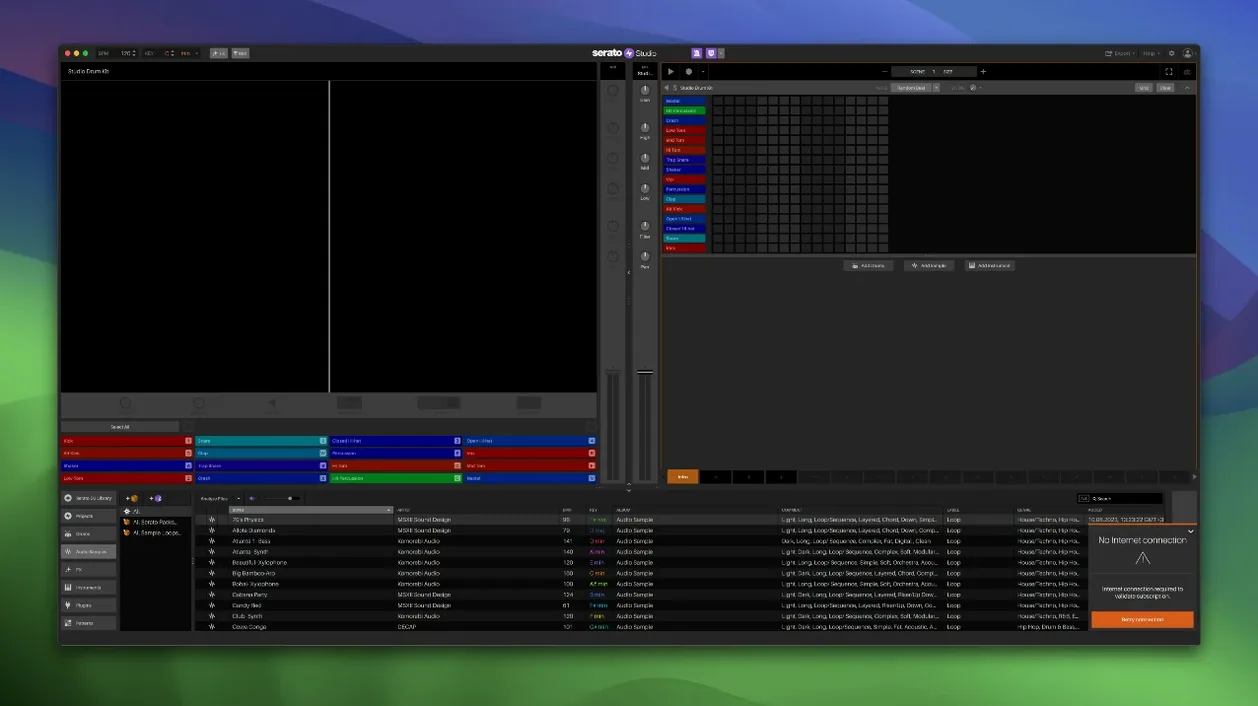
A vocal loop, a kick pattern in your head, twenty minutes before the idea fades. Serato Studio opens to a blank scene.
Where does the groove start?
Drag a drum kit onto a slot. Patterns snap to the project tempo.
Can it split a sample I have?
Drop a track into a Sample Deck. Acapella, melody, bass and drums separate. Mute what you don't need.
Wrong key?
Your Serato DJ library sits right there. Crates, cues, waveforms — no export, no relink. If you already tag tracks with color codes and ratings, Studio inherits them. That means you can build a beat around a vocal you played last weekend, with the phrasing already mapped.
Connections
Plug in a Serato DJ controller. Studio maps performance pads, encoders and the crossfader without a manual. The mixer channel gives you a three-band EQ plus a filter — the same layout you know. That makes stems automation feel like a live blend, not a drawn envelope.
AU and VST plug-ins load in the Master channel and per deck. A short chain — compressor, EQ, limiter — keeps things loud without chasing mixdowns elsewhere. Export individual stems when you need them finished in another DAW.
Pad order fix
Open Preferences and do three things.
Turn on Reverse Pad Order if your controller feels upside-down. Pick a default key, not C major — something you actually sing or sample in. Set the Feel slider to about 60% for chords; it softens the attack so progressions breathe.
Week one
Make a Scene early. Drop a kit, a bass and a loop, then switch to Scene View and automate stems — bring the vocal in halfway, kill the drums for a bar. You learn the grid faster when you arrange early.
Use Auto Chord before you touch a keyboard. Pick a pad, let it generate four chords in key, then swap one by ear. The chord set becomes your palette, not a cage.
If you search for serato studio torrent or a serato mac torrent, you already know the library. But the real unlock is dragging a live DJ set into a Sample Deck and hearing the stems peel apart — that moment rewires how you think about production. A Serato Studio crack Mac lets you test that feeling right away. Once the stems levels move with automation, the line between remix and original blurs.
Keep the Master channel lean. One limiter, one utility EQ. Move loudness decisions to the individual decks — that habit pays off when you export stems later.
Change it with one touch; the timing stays. Color-coded waveforms show where the transients land.