
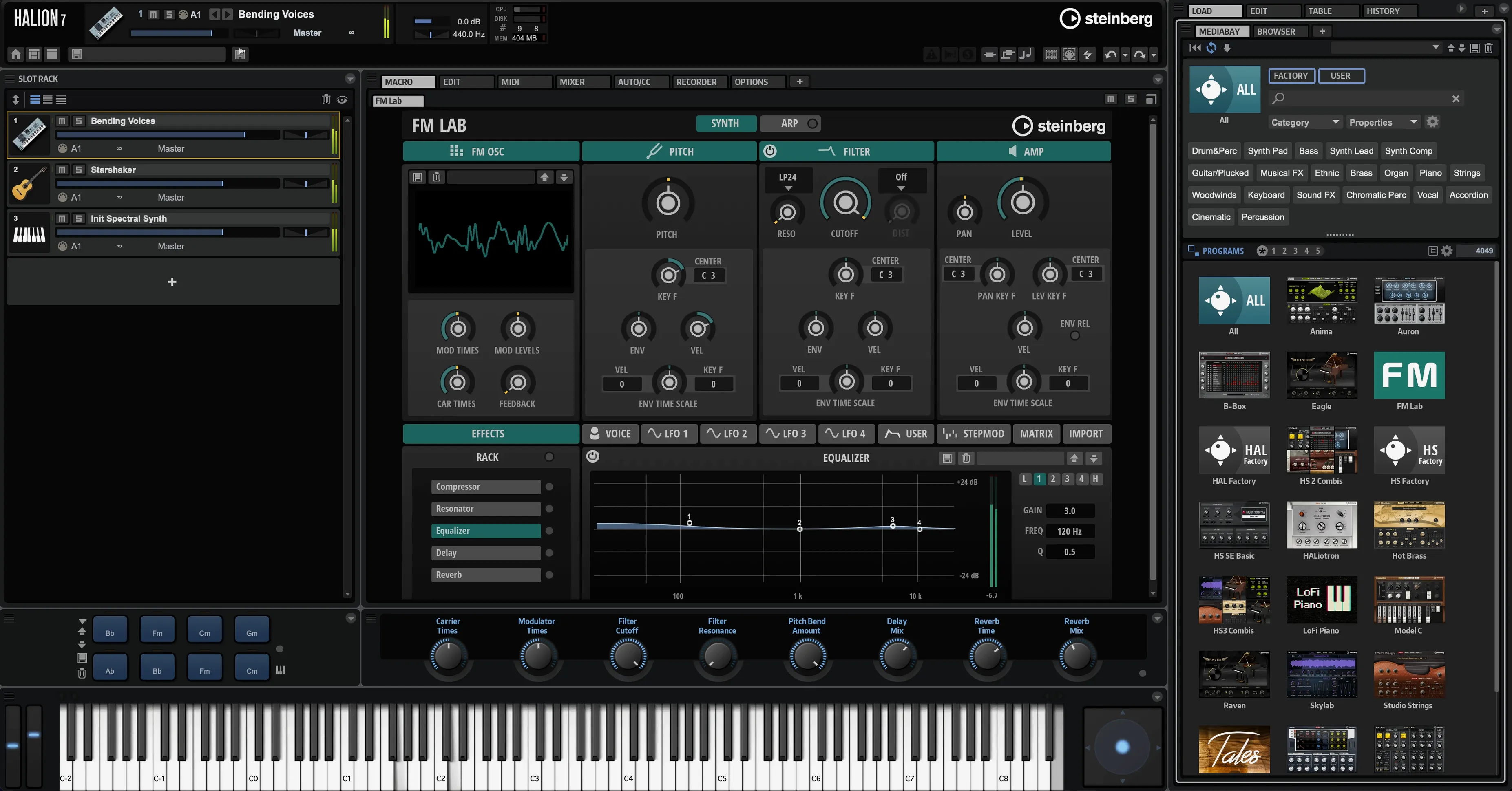
A wavetable oscillator, and somewhere inside the static waveform, a grain of motion to find.
- Load a sample or pick one of six synthesis engines.
- Drag a cable from an LFO to the filter cutoff.
- Write a Lua script that changes how the interface responds.
- Resynthesize. Stretch a transient until it becomes a pad.
- Save the instrument. It plays in any VST, AU or AAX host.
Space hunger
HALion is not a small plug-in. The download sits above 30 GB with the full library — the core application is leaner, but the factory content demands space. An external SSD is sensible. The sample engine streams from disk, so a fast drive matters more than you might guess.
Which format do you need? VST3, AU and AAX all ship in the same installer. No separate downloads to juggle. It runs native on Apple Silicon and Intel; no Rosetta layer to worry about.
People ask whether HALion replaces their current synth collection. The answer is rarely yes and often no — it sits beside them. You reach for HALion when a preset cannot go where the track needs to go. That is the trade-off. More depth, more minutes spent building.
Under load
A single instance with a complex multi-layer instrument and a dozen modulators sits comfortably at low CPU on an M-series Mac. The sample engine is the quiet workhorse here — disk streaming is transparent, even with long, unlooped recordings.
Where you feel the weight is patch loading. A deeply scripted library instrument with a custom UI takes a beat to appear. Once loaded, it stays responsive. Automation is snappy. The real-time decompose and spectral processing are the hungriest modules; stack three of those and the fan will wake up.
Stability in daily use is uneventful. It does not crash hosts. It does not leak memory across long sessions. That steadiness makes it a safe choice for a live rig, where a silent drop-out is not an option.
Screech resynthesis
A sound designer needs a riser that does not sound like a riser library. She opens HALion, drops a field recording of a train door closing into the sample editor. She isolates the screech with the spectral display, then applies real-time decompose to separate the tonal whine from the noise. The noise becomes a granular cloud. The whine gets mapped across three octaves with MPE pitch bend per note. A slow random LFO tilts the wavetable position. By 3 p.m. she has something that rises without ever announcing itself — and that nobody else owns.
Build, bend, save. HALion is a construction kit for people who prefer their own sound. With MPE, every note bends on its own.