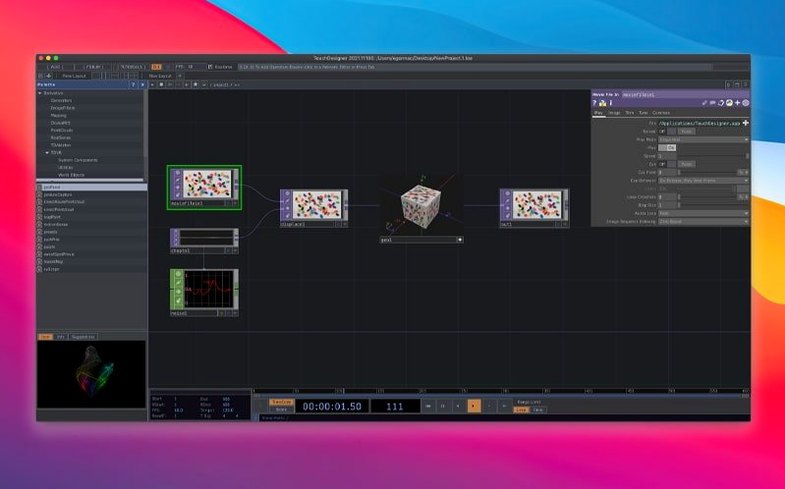
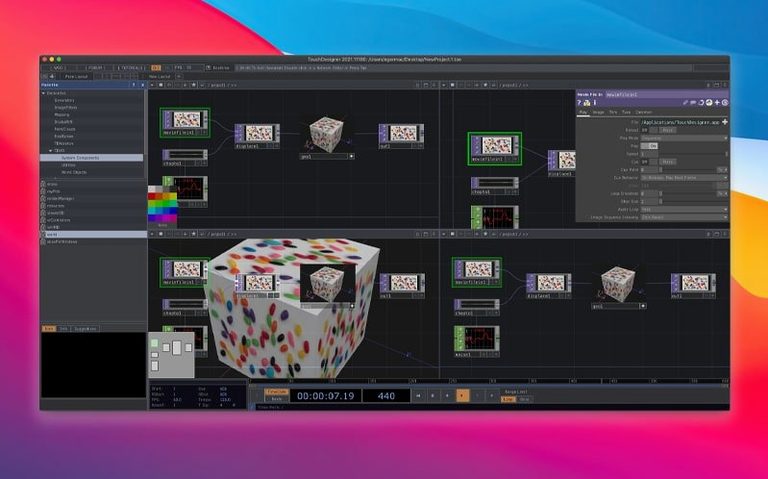
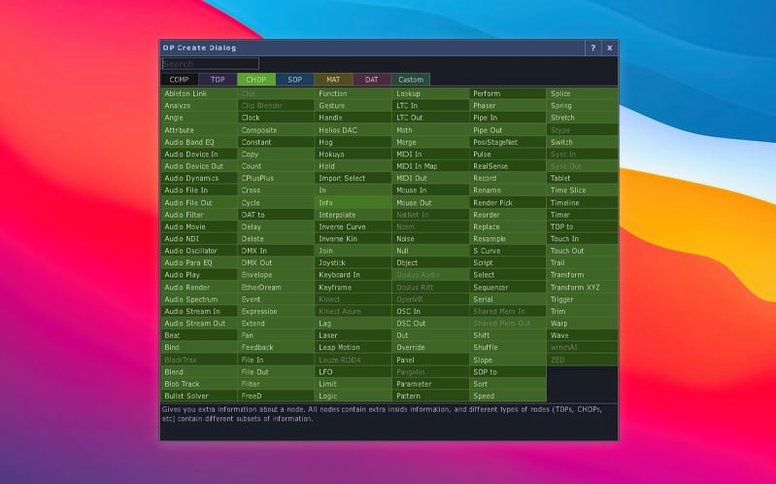
Point Operators change how geometry is built. A POP network moves, deforms and scatters particles on the GPU.
Feed a microphone into a CHOP, pipe the level into a POP simulation, and every spike in volume throws points outward. Sound in, 3D out, one window.
VR tools are built in, so you can check a scene in a headset without another app.
When you open TouchDesigner for the first time, it looks like a blank slate. That’s the trap. Beginners often start dragging OP families from the palette like LEGO bricks, without checking what network they’re dropping into. If you place a TOP inside a CHOP network, nothing happens. The node turns red. The fix is simple: right-click, build the correct family, but new users blame the software instead of the container.
Another early mistake is ignoring the Perform mode. People edit while the timeline runs and wonder why a slider snaps back to zero. Hit F1 to toggle Edit and Perform. Edit freezes values; Perform lets timeline logic take over.
Cursor home shortcut
Press H to home the network view on your cursor. It sounds trivial, but in a network that sprawls across three screens, one key saves you from scrolling into oblivion.
Shift-drag a wire to insert a node en route. The connections re-route automatically. Middle-click a node to see its output in a floating viewer. That viewer stays open until you middle-click somewhere else, so you can compare two renders without docking panels.
Hold Ctrl and drag a parameter box onto another to create a reference. The second parameter now follows the first. No CHOP. No script. One gesture.
If you search for touchdesigner torrent or touch designer torrent to get a build for a show machine, note that the same .toe file plays identically on an Intel Mac and a Windows box. Derivative’s format is cross-platform. You can develop on macOS and run the final piece on a PC in the gallery.
Retina UI scaling
The default UI scaling assumes a certain screen density. On a Retina display, go to Edit > Preferences > UI and bump the scaling to 1.5 or 2.0. Text becomes readable without squinting.
Next, open Edit > Preferences > DATs and set the default table editor behavior to Direct Edit. The old cell-selection model is fine for spreadsheets, but when you adjust a list of DMX channels in a DAT table, you want keystrokes to land inside cells immediately.
Turn on Realtime in the timeline transport by default. TouchDesigner ships with a frame-locked timeline that waits for your target FPS. For audio-reactive sketches, Realtime keeps playback synced to wall-clock time, so audio buffers don’t drift. You find it under the transport bar’s clock icon — not obvious, but essential.
One overlooked setting lives in Edit > Preferences > TOPs: Pixel Format. The default is 8-bit fixed. If you work with HDR video or a TouchDesigner Mac torrent build that feeds a Blackmagic card, switch it to 16-bit float. The difference shows in gradients. Banding disappears.
And if you’re following the #touchdesigner latest chatter about POPs, set your viewer’s render picker to Point mode before you judge performance. The default draws geometry as a solid mesh. POPs output point clouds; rendering them as shaded triangles wastes GPU cycles and hides the structure you came to see.
You build. You see it move.