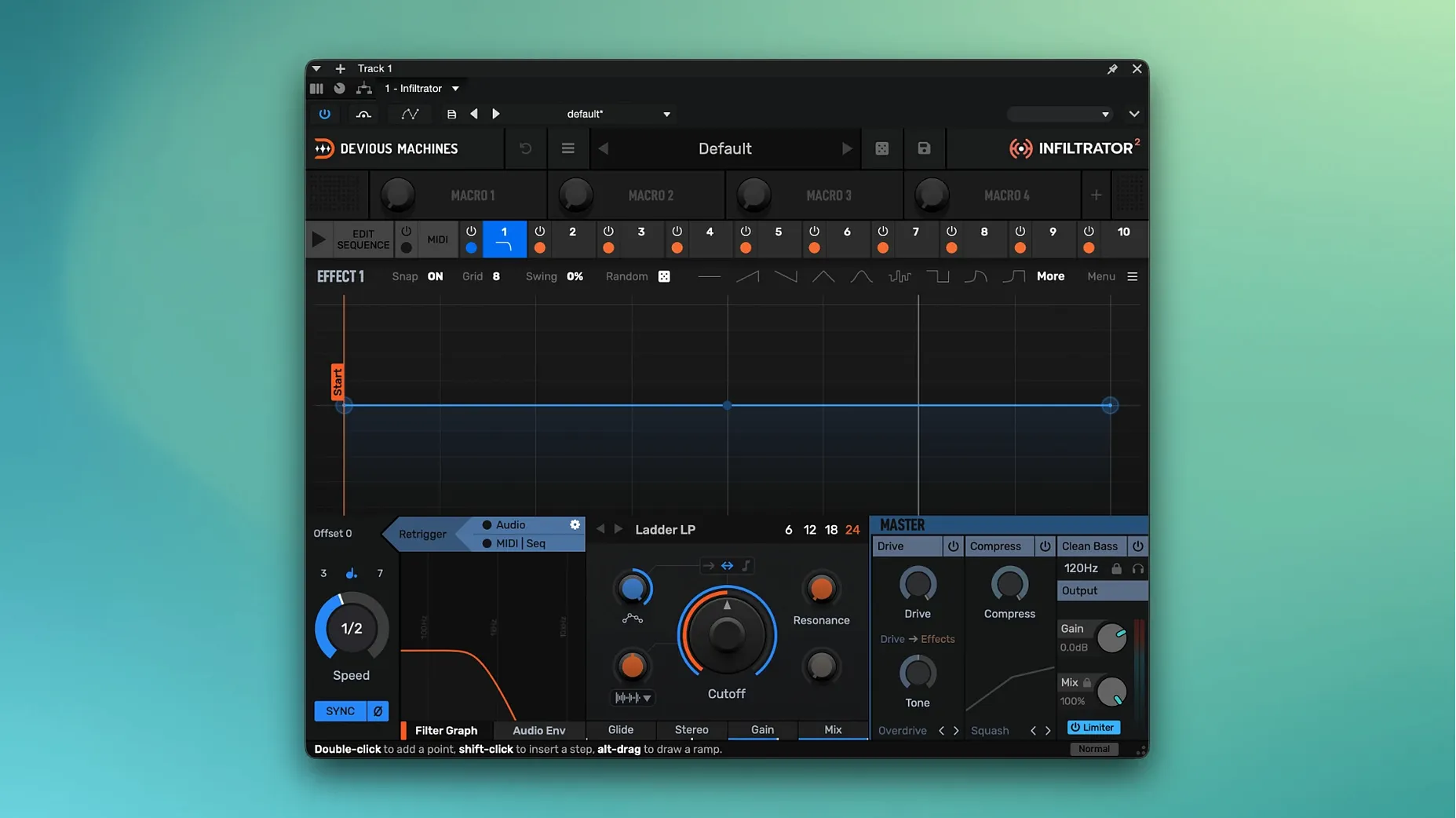
Getting a riser to move usually means juggling five plug-ins. Infiltrator removes the routing.
Insert — on a synth track, when one reverb and a filter are not enough.
Bus — the natural home for heavily modulated texture layers.
Master — rarely, but the output limiter added in 2.5 makes it possible.
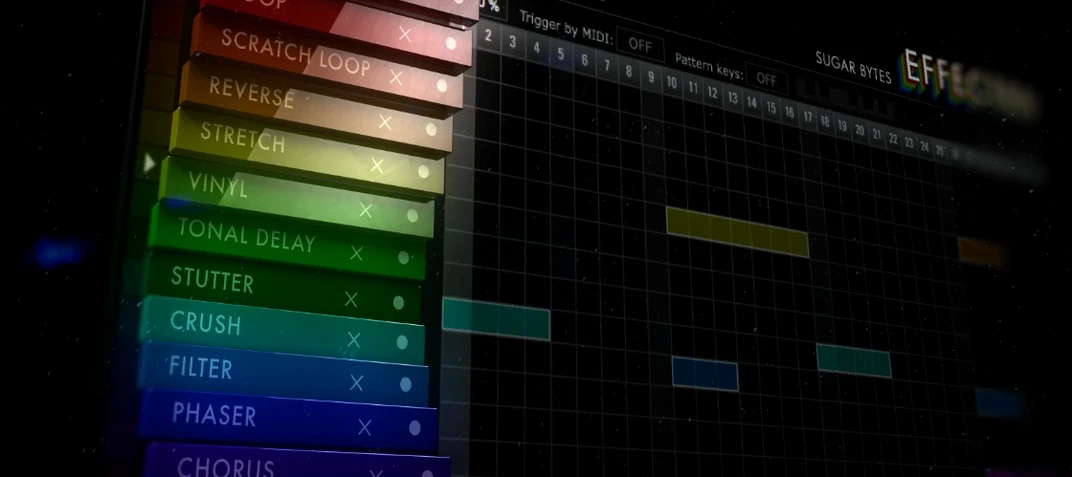
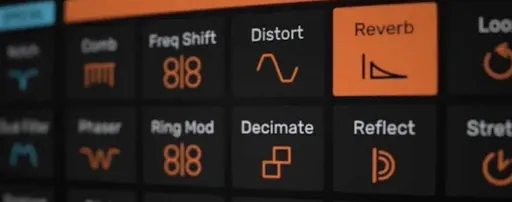
Chain — up to ten effects in series.
Modulation — an LFO, envelope follower or step sequencer on any parameter.
Sequencing — step through effects in time, like a programmable multi-effects pedal.
Random LFO
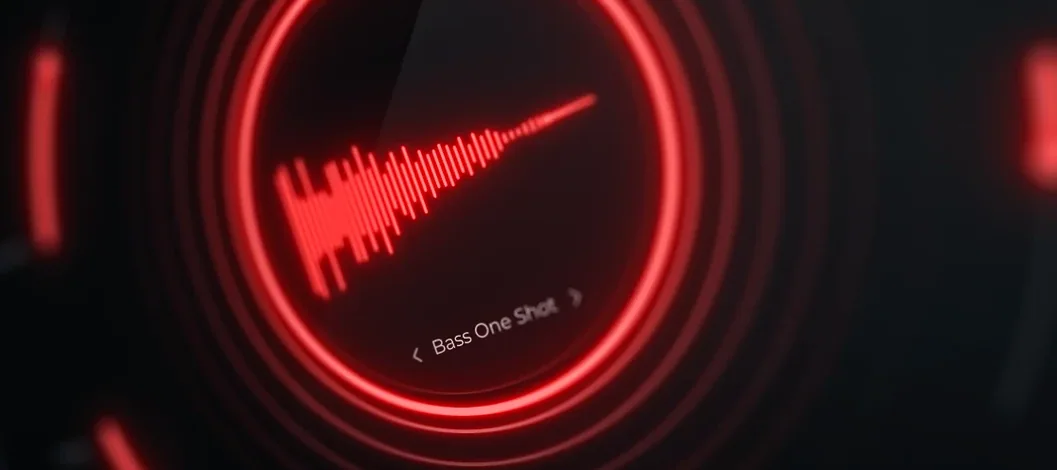
Drop Infiltrator on a dry bass loop. Mute everything except a band-pass filter and a soft clipper.
First, drag the filter cutoff to taste. Then open the modulation panel. Assign an LFO with a slow rate and a random shape. The bass breathes — tight, then wide, then tight again.
Add a delay to the second slot. Set it to a dotted eighth. Use the sequencer to trigger the delay only on the last two steps of a four-bar pattern. The loop stays clean until it needs to tail off.
Slot three gets a pitch shifter, +7 semitones. Route the envelope follower to its mix level. Now the octave-up harmonic only appears when the note starts hard. It vanishes as the sound decays.
Slot four: a reverb, 100% mix, gated. Sequence it to open for one step every two bars. The room blooms once, then shuts.
Lock the master dry/wet near 60%. Save the preset. The whole process took under two minutes.
Instant mod
Right-click any knob to assign a modulator instantly. No menu diving.
Hold Alt while dragging a sequencer step to set its value in fine increments. Useful for mixing in a touch of saturation without overshooting.
The effect order can be rearranged by dragging the slot labels left or right. This changes the character of a chain more than you expect — try placing the delay before the filter once.
Each modulator has its own smoothing control. A tiny bit of glide on a stepped LFO warms the transitions without losing the shape.
Custom beat divisions, added in 2.5, let you set a delay to three sixteenth notes instead of a standard dotted value. Rhythms get more human this way.
2.5 in daily use
The output limiter changes the master-bus scenario. Before, a rogue resonance could spike past 0 dBFS with no protection. Now you can push a resonant filter sweep hard and trust the end-of-chain ceiling. It’s a small addition that removes one reason to insert a separate limiter afterward.
Custom beat divisions spread across every tempo-synced module. Delays, LFOs, and sequencer clocks all accept them. If you have ever wanted a filter LFO to cycle every five sixteenth notes against a four-four beat, this is how it feels — a slow drift that never quite repeats where you expect.
Preset loading is faster than in the original Infiltrator. Browsing patches no longer causes a tiny pause during playback. The difference is small in isolation, but during a long arrangement it keeps your attention on the sound.