
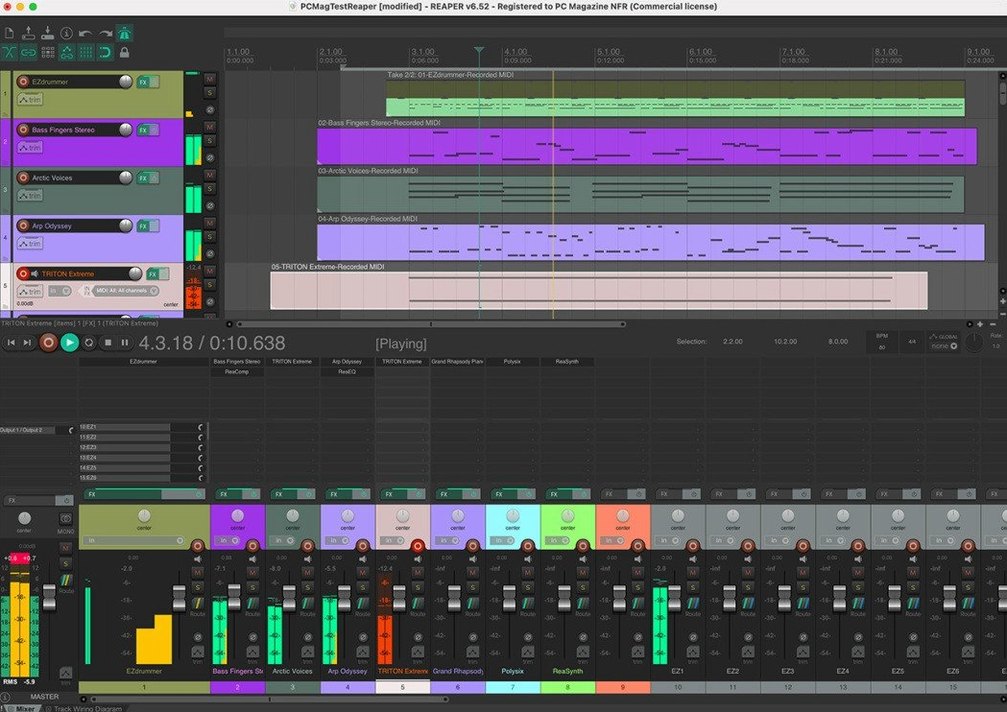
REAPER is a digital audio workstation. Recording, cutting, mixing and mastering live here.
1. Bring in material. A vocal take, a guitar stem, a synth captured as MIDI. Audio and MIDI sit side by side.
2. Arrange. A track for the kick, one for the snare, both in a folder. The children route into the parent on their own. Big sessions reach 128 MIDI inputs and 512 loopback channels.
3. Shape. Plug-ins, automation, or a script for a repetitive edit.
Musicians tracking live instruments, post-production editors tidying up dialogue, and anyone building layered MIDI compositions tend to wear REAPER the hardest. The reason is routing. A sound designer who needs to send a single snare hit through three chains and back into a folder for non-destructive freezing doesn’t hit a wall. They right-click, add a send. Done.
Podcasters who treat a voice as raw material get similar mileage. A track template with a noise gate, a de-esser, and a loudness meter loads in seconds. No fighting the mixer architecture.
Empty warehouse
A blank arrange view on first launch can feel like an empty warehouse. The fix is a template. Set up a few tracks, add a reverb bus, save as the default project. Next time the warehouse has lights on.
Another common hitch is the media explorer not showing waveform previews. REAPER builds a peak cache; if the drive is slow or the folder holds thousands of long files, the preview lags. Pointing the peak cache to a fast internal drive in Preferences > Media clears it up.
Plug-in scanning after an update sometimes skips a newly installed AU or VST3. A manual clear-and-rescan from the VST preferences forces a fresh index. The scan runs deep — leave it a minute.
People occasionally grab a reaper mac crack from a torrent and find that scripting extensions or SWS actions refuse to load. The install was partial. A clean drag from a full universal disk image and a proper patch afterward puts everything back where the application expects it.
Stem rescue
A singer-songwriter brings a half-finished Logic session exported as stems. She wants to re-track the vocals and keep the rest. In REAPER she drops the stems onto separate tracks, color-codes them, and lowers the old vocal guide. A new take gets punched in with pre-roll. She applies a light compression chain, references the mix on a loudness meter, and renders a region for the band’s group chat. No import wizard, no track-type conversion. Just files on a timeline.
Alongside everything else
REAPER reads Broadcast WAV timestamps, so a field recorder’s polywav dropped onto a track snaps to its original timecode. That makes it a natural partner for video editors who clean audio in REAPER and pull it back into DaVinci Resolve or Final Cut Pro via AAF or plain WAV export.
Soundminer and BaseHead users route system audio into REAPER using the loopback channels. Spotting sound effects from a library manager into a timeline becomes a one-click affair. For composers who write in Dorico or Sibelius, a MIDI export lands in REAPER with tempo maps intact. The arrange view follows the conductor’s marks.
macOS’s Audio MIDI Setup sees REAPER’s aggregate device support without fuss. Aggregate a Thunderbolt interface with the built-in output for a quick headphone check, no third-party utility needed. And because the app is a single drag-and-drop bundle, backing up a configured portable install is just copying the .app and the resource folder onto a USB stick. No authorization wizards.
When someone hunts for a reaper daw torrent because they want to test a dense orchestral template before committing, they often discover the routing holds up better than expected. The same portable install opens on a house Mac at a venue, runs the backing tracks, and nobody in the audience notices the computer.
A demo, a band, a film score. Same app.