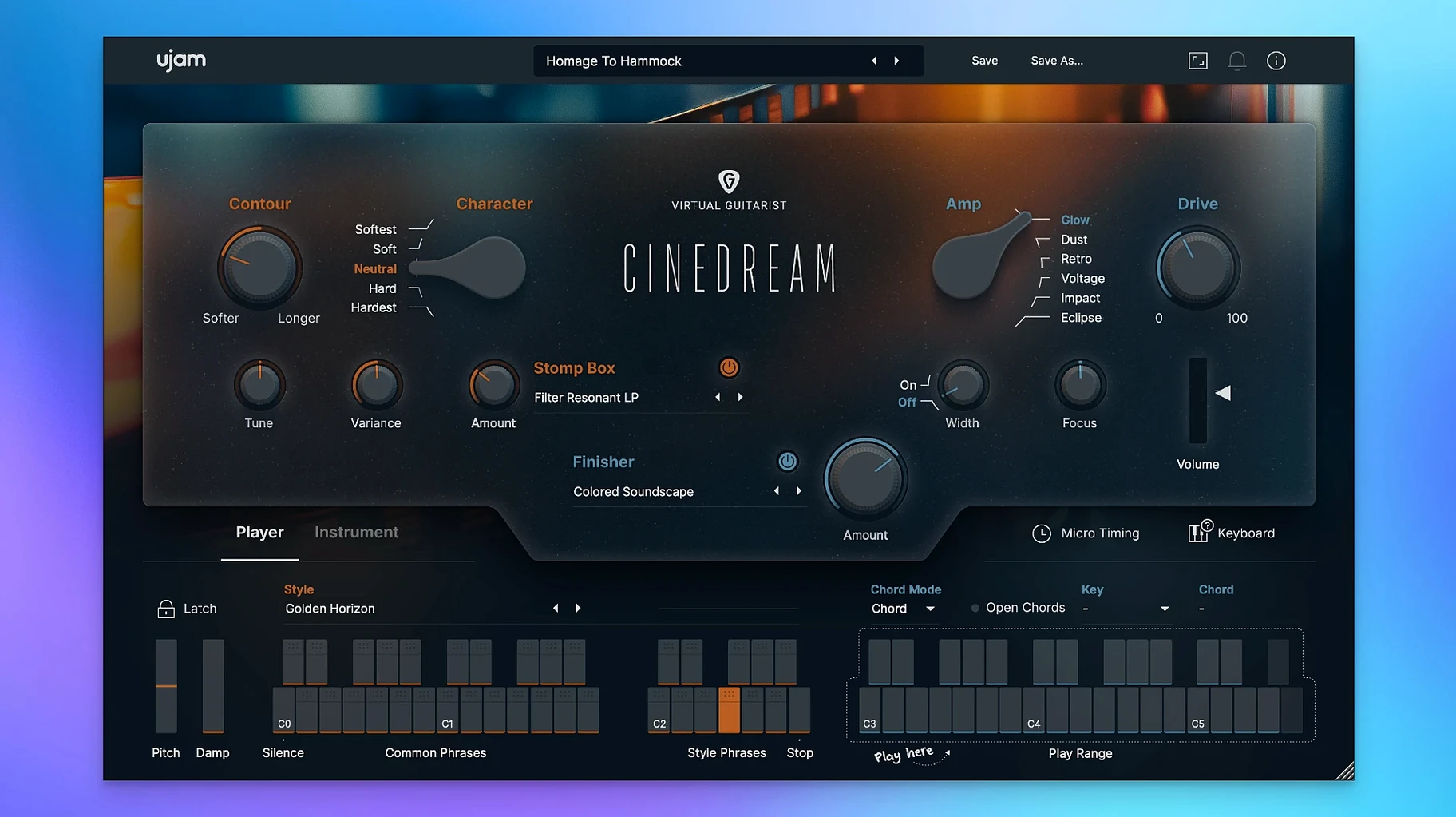
Cinedream plays ambient, cinematic guitar textures.
- Score beds that need slow, evolving tone rather than riffs
- On a bus, to wash a whole section in harmonic movement
- From clean, soft pads to saturated, rough layers in one plug-in
Tweak first
Open Cinedream, and the Style browser greets you first. Resist it.
Flip to the Finisher section. Cinedream ships with the Finisher knob at noon and a default chain that does fine work — but the moment you pull it back to zero, the raw guitar texture breathes differently. Do this once. Hear the untreated instrument. Then reintroduce the effect to taste.
Next, dial the Character control down to the soft, clean extreme. Every style becomes less assertive here; the transient softens, the harmonic wash sits further back. On a denser session with a piano lead or a vocal, this small move keeps Cinedream from crowding the center. For a solo ambient passage, push Character the other way — the saturation roughens the edges just enough.
Score a drone
You need ninety seconds of slow-moving tension under a scene with no dialogue.
Pull in an instance of Cinedream on an instrument track. From the Style browser, pick a long, pad-like style — something that moves on the chord trigger, not the clock. Disable your DAW's metronome. Cinedream does not need tempo to work.
Play a single minor chord and let go. The chord trigger sustains and evolves. Work through a few voicings, holding each for eight to twelve seconds. You are listening for the moment the internal modulation shifts — a harmonic swell, a tremolo arc, a tape-like warble that catches the room tone.
Once you land on three or four voicings that sustain the right weight, record them as one long pass. On playback, place fades between the held chords so the transitions feel like a photographer racking focus, not a guitar changing hands.
With the core drone in place, run the bus through a long reverb at the channel level — not inside Cinedream. The plug-in's own ambience handles texture; an external reverb tail gives the drone a shared space with the rest of the score.
Midnight texture run
It is well past midnight.
Cinedream sits on a stereo instrument track, AU version, Logic pulling a modest twenty-track session. You are layering texture behind a sparse piano figure.
You load a style you have never used before — something broad and distant, with the modulation display pulsing in slow, irregular arcs. You hold a cmaj9 and watch the waveform window as the tone drifts from clean to softly overdriven over fourteen seconds. No MIDI programming. No automation yet. Just the chord trigger letting the sample engine do its work.
You dial the Dynamics knob to taste — just a gentle rise, never a leap. Then you open the microphone mix section, pull the ribbon mic a hair forward, and lock in a stereo width that frames the piano without fighting it. The piano stays in front. Cinedream pulls the wall backward, slowly.
You record a single eight-bar pass. Playback catches something you did not consciously perform — a ghost overtone exactly where a cymbal swells. You keep it.
Plug-in to picture
Cinedream works as a plug-in, so drag it into any track where macOS and your DAW already cooperate. AU on Logic, VST3 on Cubase or Studio One — the instrument loads the same library whichever format the session demands.
Combine it with Space Designer or ChromaVerb. Cinedream handles the near-field wash; the convolution reverb pushes the tail into a believable room, hall, or concrete bunker. On an Intel Mac or Apple silicon — native or through Rosetta — the thickest textures stay light on the CPU meter, even when a convolution tail follows it.
The instrument talks well with Quick Sampler, too. Record a Cinedream drone to audio, drag it into Quick Sampler, and play it back tuned, sliced, or reversed. The processed real-guitar source becomes raw material for a digital instrument — when a cinedream free download gets you in the door, it is worth exploring what the raw audio gives you beyond the plug-in's own interface. Once the sample is inside a macOS-native sampler, the guitar texture becomes just another voice in a larger instrument build.
It belongs to UJAM's Virtual Guitarist family: a focused, player-driven sound, not a general synth. VST2, VST3, AU and AAX.